
Noise Regs 2005 · Reg 9
Protect hearing before it’s gone.
Noise-induced hearing loss is permanent, and it can be prevented. Our 20-minute on-site audiometry assessment keeps your people protected and your business compliant with the Control of Noise at Work Regulations 2005.

Safeguarding your workforce
Under the Control of Noise at Work Regulations 2005, employers must provide health surveillance for employees exposed to noise above 85 dB(A). Compliance makes sure that noise exposure doesn’t lead to permanent hearing damage, and protects your business from legal consequences.
A growing concern for employers
An estimated 10 million people in the UK live with hearing loss, and that’s projected to rise to 14.1 million by 2031, nearly 20% of the population. Over 1.1 million workers in Britain are exposed to noise above 80 dB(A), which makes hearing health an increasingly critical issue.
- people in the UK live with hearing loss
- 10m
- projected by 2031: nearly 1 in 5 of us
- 14.1m
- British workers exposed above 80 dB(A)
- 1.1m
What happens
The process, step by step.

- 01
Questionnaire
A short health and noise-history questionnaire, sent in advance through the portal.
- 02
Ear examination
Otoscopy by a trained practitioner to check the ear canal and drum.
- 03
Audiometry test
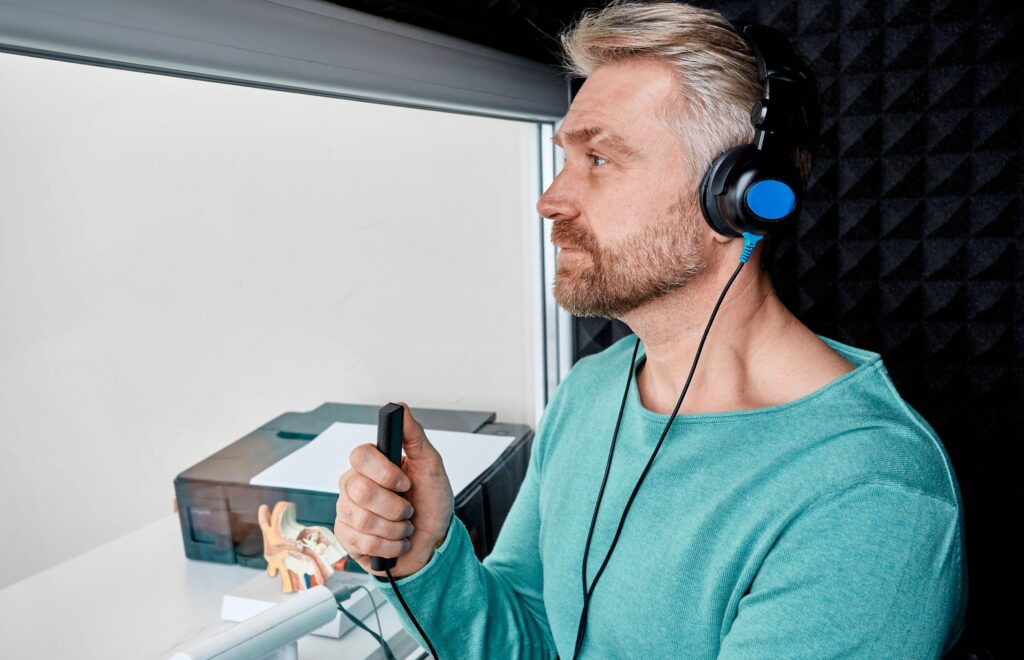
Pure-tone audiometry in a quiet room on your site.
- 04
Report & categorise
Results are categorised under HSE guidance, with clear actions for anyone who needs follow-up.
FAQs
Audiometry: questions.
What noise level triggers health surveillance?
Surveillance is required where employees are regularly exposed above the upper exposure action value of 85 dB(A), or where your risk assessment shows a risk to hearing at lower levels, for example for employees who are particularly sensitive.
Do we need a soundproof booth?
No. We test on-site in a suitably quiet room, so your people aren’t away from work for longer than the 20-minute assessment.
Surveillance checker
Anything else you need?
Most workplaces have more than one hazard. Add the rest and see your full surveillance programme.
Step 1 · Tick everything your people are exposed to
Step 2 · What you’re likely to need
0 programmes
Select the hazards in your workplace and we’ll show which health surveillance applies, the regulation behind it and how often it’s due.
General guidance based on HSE regulations. Your risk assessment decides what’s required, and we’ll confirm it with you.
Related
You might also need.
 COSHH 2002 · Reg 11
COSHH surveillanceAnnual skin and lung-function checks for people who work with dust, fumes, vapours, flour or spices.Learn more
 Vibration Regs 2005 · Reg 7
Hand-arm vibrationHAVS health surveillance for anyone using vibrating hand-held tools such as breakers, saws and grinders.Learn more
 COSHH 2002 · Biological monitoring
Biological monitoringUrine monitoring and asthma surveillance for paint sprayers and body makers exposed to isocyanates.Learn more